Showing posts with label advertising. Show all posts

Monday, 3 August 2015

The Illuminated Public Indicator Company

THE ILLUMINATED PUBLIC INDICATOR

The desideratum of a general public indicator, or pillar directory, calculated to afford a correct guide to the ever-moving masses of the metropolis, was practically realised on Thursday night by the establishment at Hyde Park-corner, Piccadilly, of an elegantly illuminated column or pharos in the centre of the thoroughfare, called by the enterprising company who have projected it, a general public indicator, the first of a series of similar district columns or obelisks, of sexagonal form, and which the author of the design, Mr T. A. Pouteau, of Belgrave House, Hampstead, has obtained permission to erect in the leading thoroughfares. These columns will form not only a highly elegant and ornamental, but a practically useful feature in all the central routes of the metropolis. The one at Hyde Park is some twenty-seven feet high by seventeen feet six inches round, and forms a refuge for pedestrians in the centre of that dangerous debouchement of vehicles from the Park. The column is richly gilt, by Mr Dickenson, of Cumberland-market, Regent's Park. Plate glass is let in down the entire shaft, which at night is illuminated down the centre, displaying on all sides advertisements and other transparencies of public information, which will go to pay the cost of the construction. The tout ensemble is surmounted with a very handsomely and richly ornamented lantern light, containing a much larger amount of gas-burners than any at present in operation. The primary and public uses of the indicator will be that in each locality where erected there will be found within them a post-office, and upon them instructions on the following points, viz. :—Indication of the nearest branch post-office—fire-engine station—fire escape—police station—alms box for poor—measured distances and cabriolet fares—all the squares, bridges, and public buildings, and all such parochial and public information as maybe generally useful.

Caledonian Mercury 27 June 1859


HYDE PARK CORNER.
TO THE EDITOR OF THE TIMES

Sir,—Exactly opposite to Apsley-house a Small circular harbour of refuge for pedestrians has lately boon constructed in the middle of the street, into which they may scud when overpressed by stress of omnibuses and hack cabs, I do not know by whose authority this has been done, nor does it much matter; it has been well done, and the little haven is a great protection and comfort to everybody, especially to old people, cripples, and children.
    It would, perhaps, be more exact if I were to say that it would have been a great protection to such helpless ones had not some idiot (I use the mildest term applicable to this case) bethought him of establishing in its centre a gaudy glass column, obscenely splendid by day with gilding and the lowest class of advertisements, and by night a pillar of fire, such as of old led the chosen people through the desert, and such as will now frighten any decent cab horse out of its wits.
   Strong recommendations to hurry to the Casino and to Cremorne are thereupon intermingled with the manifestoes of anti-bilious pill-makers and with the mysterious suggestions of the Silent Friend, the place of honour on the western front being conceded to the questionable merits of Dr. Kahn's Venereal Museum. On the top of this frightful edifice are denoted by letters the four points of the compass; underneath is a small clock, superfluous from the fact that a much larger one (that over the Hyde Park Lodge) is in sight within 50 yards ; then we have the days of the week and month, then the various trashy advertisements to which I have alluded.
    Below are given the hackney carriage fares; the names and times of the omnibuses which ply along Piccadilly ; the addresses of the various parochial dignitaries, and of the police offices and stations. In short, the column is evidently intended to supply to bystanders much of the information usually found in a local almanac and to be a source of revenue to somebody through its advertising powers.
    Many of these details are given in very small print, and only the upper portion of the pillar—the advertising portion—is lighted up at night. The inevitable consequence is that the entire apace
intended for the protection of the old, the infirm, and the young, while crossing Piccadilly, is permanently occupied by persons consulting the hackney coach fares—looking for the day of the week or month, seeking the address of the beadle or the tax-gatherer, or pondering whether they had better have their families' likenesses taken at Messrs. Chisle'em's studio for a shilling a-head—take them to dance at Cremorne—hear Dr. Kahn's full. flavoured lecture—dose them with anti-bilious pills, or blow them out with Revalenta Arabica.
    Pedestrians, instead of being benefited by the arrangement, are thus forced far out of their reckoning into the chaos of Piccadilly to escape the crowd which the idiot who put up this ignoble contrivance has succeeded in establishing there and unless the higher powers of the parish or of the
State will at once interfere many days cannot possibly elapse before some deplorable accident is occasioned by it.
    I respectfully seek to know who directed this trumpery affair to be put up, who conceived and executed it, and on what pecuniary terms it has been erected?
    I am, Sir, your obedient servant,

    A BELGRAVIAN.

The Times 27 June 1859


THE ILLUMINATED PUBLIC INDICATOR COMPANY
TO THE EDITOR OF THE TIMES. 

Sir,—Since I had the honour of addressing you on the subject of the astounding advertising post
erected opposite Apsley-house, a printed circular has been placed in my hands, signed by a person named Ponsonby, who styles himself "Manager of the Illuminated Public Indicator Company," and dated from their offices, 17., Southampton-street, Strand.
    This gentleman announces that his principals, have made arrangements with the authorities of the city of London, and also with the leading metropolitan parishes for the erection of indicators similar to that which has attracted so much animadversion in Piccadilly, in the principal thoroughfares of London.
   He states that they will afford instructions to the public on the following points:

"Indication of the nearest branch post office — fire-engine station — fire escape  — police station —alms-box for poor — measured distances and cabriolet fares — all the squares, bridges, and public buildings (?) — and all such parochial and public information as may be generally useful."

   Mr. Ponsonby then goes on to expatiate on the elegance and utility of these tawdry erections for advertising. For  a very small sum (24s. per pane for four weeks) he undertakes to advertise anything and everything, from ginger beer to commissions in the cavalry, day and night, in all the most
prominent positions about the metropolis.
    Now, Sir, if the proprietors of the Illuminated Public Indicator choose to hire houses in any of
our streets, there can be no objection to their advertising whatever they please in the windows of those houses, and charging what they please for such advertisements; but it is surely intolerable that they should be permitted to collect crowds in the precise places where crowds are exposed to most danger when so collected—as at the crossing in Piccadilly— simply with the view of making a profit at  the risk and at the expense of the public.
    The information which they propose to impart is merely put forward as a peg on which to hang their money speculations ; I don't deny that it may be very useful information ; but the middle of a dangerously crowded thoroughfare is decidedly not the proper spot in which to impart it ; any more than it is to acquaint the lieges with the geography of Northern Italy, or the state of the poll at the Oxford election.
   I do hone, Sir, that you will use all your influence to extinguish these abominable illuminated indicators as soon as may be.

Your obedient servant,
June 28. A BELGRAVIAN

The Times 29 June 1859
THE ILLUMINATED PUBLIC INDICATOR
During the ensuing week, TWO INDICATORS will be placed respectively - ONE at CORNHILL and ONE at WHITEHALL - For particulars and information, apply at the offices. 11, Southampton-street, Strand, W.C. THOMAS T. PONSONBY, Manager

Daily News 1 July 1859

The good people to the out of Temple-bar have displayed greater spirit as respects the so-called Public Indicators than their western fellow-townsmen. The other day preparations were made for erecting one of these monstrosities. at Exchange-buildings but the workmen employed were compelled to desist from their operations. The  company were then served with notices by the parish of St. Michael, Cornhill, with threats of an appeal to the Court of Chancery, if the notices were not found sufficient. They have not, however, ventured to push matters to extremity, and the pavement has boon restored to its original state. It seems a pity that the inhabitants at the western extremity of London will not employ similar moans to got rid of the deformity opposite Apsley-house. Of course, we are not recommending a breach of the peace, but simply that lawful and proper means should be
taken to compel the parochial authorities to rescind their contract with the company, if a contract exists, or, at any rate, to recall the licence under which this public nuisance has been erected. Surely the roads and streetways of the metropolis an encumbered enough in all conscience without any endeavour gratuitously to diminish the space, already far too narrow, set aside for the public accommodation! There really is no reason why by night as well as by day we should have one of Mr. ALBERT SMITH'S China plates, or an image of the Talking Fish standing upon its tail and holding a dialogue with a mariner, kept continually before our eyes. The inhabitants of London do not want at all hours between sunset and sunrise to be asked "if they have bought six Eureka shirts," or, "Do they bruise their oats yet?" Will any one seriously pretend that the announcements made on these Indicators are of any use or moment to the public? The whole process is just that of illuminated billsticking for the profit of the bill-stickers—nothing more.

The Times 15 December 1859


ILLUMINATED PUBLIC INDICATOR - Notice is hereby given that unless the PUBLIC INDICATOR which has been removed from the Borough-road be TAKEN AWAY on or before the 31st July inst. and the expense to which the hereafter mentioned Vestry has been put be duly paid, the said indicator will be SOLD to pay the expenses incurred.
By Order of the Vestry of the Parish of St. George-the-Martyr, Southwark

The Times 10 July 1861


Thursday, 17 May 2012

Pavement Advertisements

Here's a new one on me - pavement advertising in the West End, 1856 (as recounted by French visitor Francis Wey, 'A Frenchman sees the English in the Fifties', transl. 1932). What is he talking about? Could be pavement chalking, but that would hardly work after wet weather. Anyone heard of anything similar?

'Publicity invades even the asphalt pavement. It relies on the frequent rain and the habit the people have over here of looking down as they walk. When the weather is fine, dust dulls the surface and nothing much is visible. But as soon as a shower has washed it clean the characters appear, letters blossom under your feet and you find yourself walking on gigantic posters. In this way, the stone flags of London are made as productive as fields of wheat.'

Wednesday, 13 October 2010

Face Bleach and 'advertising big'

Following my post last month on the interesting life of Anna Ruppert, I'm pleased to receive further information from Kristin Huston, a postgraduate student at University of Missouri-Kansas City, who found a fascinating interview for me (below), which suggests that Mrs. Ruppert's business continued in America after her alleged death in Missouri, and gives a good deal more background to how it got started. It also throws a lot of light on the early advertising industry in the US, for good measure:

"Mr.L.L.Hill, the advertising manager of Madame Anna Ruppert, the complexion specialist, has the reputation of being an enthusiast on advertising, with an experience of fifteen years to his credit, and as that experiene is said to be both vast and varied, a PRINTER'S INK representative waited upon him at his offices, 6 East Fourteenth street, the other day with a view to drawing our Mr. Hill upon advertising matters and getting an interesting story from him. Mr. Hill is not partial to interviews and does not care about publicity. But, succumbing to the blandishments of th representative of the Little Schoolmaster, he expressed himself as ready to talk. The reporter asked
    "When was the Face Bleach put on the market Mr. Hill, and where?"
    "In 1883, in Chicago. Madame Ruppert tested the Bleach repeatedly in private before introducing it to the public. When thoroughly satisfied as to its merits, it was decided to place it on the market. Our first ad was a full page in the old Chicago Times."
    "Did its results justify you in continuing?"
    "Yes, it exceeded our anticipations, and we then began advertising in the other Chicago papers. Madame Ruppert and myself believed in advertising big, if at all. Consequently, we have always used large spaces. If you want to strike the crowd, strike them heavy; give them an ad that can be seen, heard and felt, so to speak."
    "Then you don't believe in small ads?"
    "No, sir. I have always found that, other things considered, the bigger the ad, the bigger the results. What's the use of catching one fish with a little net, when a bigger one will catch a hundred?"
    "But the cost is proportionately greater?"
    "No, it isn't. In the majority of instances, the bigger the space I buy the lower the rate I pay. Besides, the public admire enterprise in an advertiser, and if he makes an imposing show people are more apt to be interested than if he made a timid bid for publicity in a few lines."
    "When did you open the New York office?"
    "Ten years ago. We first advertised in the New York papers in 1888. We used the World and the Press, and the ads wre placed for us by Mrs. Macdonald, then connected with the advertising end of some of the New York daillies. The lady is now in the Klondike, I believe."
    "Did you expect to do a better business in New York?"
    "Naturally. Besides, our coming here was part of a plan Madame Ruppert had and which we immediately carried out. This was to reach the very best New York society, which, of course, means the best in America. In order to do this we sent out thosands of dainty circulars to the names in the Elite Directory. These were followed by beautifully engraved cards of invitation to hear Madame Ruppert lecture on the 'Complexion' at the Fifth Avenue Theater. The theater was crowded with a large and ultra-fashionable audience that manifested the greatest interest in what the lecturer said. Those lectures, afterwards repeated by special request, made us many friends in New York and induced Madame Ruppert to lecture later at the Tremont Temple in Boston, and the Chestnut Street Theater in Philadelphia, at both of which places her New York success was duplicated. Many steady customers of the best society in New York, Boston and Philadelphia are still on our books as a result of those lectures nine years ago."
    "When you came to New York, you enlarged your advertising territory?"
    "Yes, we gradually extended all over the country, establishing branch offices in large cities and advertising in the newspapers by half and whole pages."
    "You found that this paid you?"
    "We kept at it until it did pay us. It is of no use to fire a shot and run away. We stood to our guns and kept on firing until we had captured the place. We knew the value of our goods, and that a single trial would mean a regular customer. Hence we bent all our energies to secure that single trial."
    "Does your Face Bleach really help the complexion, Mr. Hill?"
    "Well, I suppose most advertisers have to answer similar qusetions about their goods, and yet they are irritating questions. The best way to answer yours is by asking you another. Do you suppose that well-known society people, representing both the wealth and brains of this city, would keep on sending their checks year after year for the Face Bleach if they did not derive actual benefit from it? You may look at the letters yourself, but remember the names are not for publication."
    Mr.Hill here handed from a file a number of letters than unquestionably came from the Fifth avenue houses of many of New York's multi-millionaires, and he showed the reporter several checks that bore the signatures of well-known society women.
    This prompted the question:
    "Which New York paper have you found best for your business, Mr. Hill?"
    "The Mail and Express has, perhaps, yielded us the best returns. It goes to a good class of people, the class we want, and it is a paper that really reaches the homes - there is no doubt of it."
    "Do you get your society patrons from that paper?"
    "Possibly - some, but as I told you before, many of our fashionable New York customers came to us through the lectures. Then again, we have used the Herald, and that goes to a good class of people too."
    "You have used the magazines also?"
    "Oh, yes, largely, all of them, and also many of the illustrated weeklies."
    "Which of the magazines yielded you the best returns?"
    "Even if I knew it would not be fair for me to answer the question. If you should quote me as saying that any particular magazine had been better than another, my words might lead other advertisers astray."
    "In what way?"
    "You can't judge either magazines or newspapers indiscriminately in that way. Mediums that are really good for your business - which, you should remember, is a peculiar one - might be utterly worthless to other advertisers. The newspapers and magazines that have paid us might not pay others, and those that have been useless to us might yield big returns to some advertisers. You know a great deal depends on what is advertised, no matter what medium you are considering."
    "Do you prepare your own ads, Mr. Hill?"
    "Mostly, yes. I have tried some of the so-called experts, but their work has never brought in the results that we have obtained from my own work. Possibly this is because my entire attention is given to the subject and I concentrate all my efforts on producing successful ads."
    "Your sales like your advertising are subject to seasons, I presume?"
    "Yes. Spring and summer are our best seasons. They constitute two thirds of our business year, and experience has taught me that advertising in fall and winter does not produce the desired results."
    "Have you ever done outdoor advertising?"
    "No, and we don't intend to. I can not be made to believe that either paint or posters are good for our business. We aim almost exclusively at reaching the better classes of the fair sex, and I do not think that wall and fence advertising appeals to them. Besides, we have a story to tell in each ad we put out, and outside advertising must be brief to be successful. Understand, I am not decrying outdoor advertising, except as it relates to my business. I believe it is a very good thing for many advertisers, but, as I said before, in choosing the medium, the thing to be advertised must be considered."
    "What is your idea of giving or sending samples of your goods?"
    "I think it is a very good plan. In the first place it conveys the idea that you have an honest confidence in your own goods. Secondly, it secures a trial of your goods, whjich, if meritorious, is certain to lead to future custom, and thirdly, it impresses the public with your generosity, and removes the popular impression that all advertisers are "graballs." Again, it is but fair to the public that it should first try a strange article that you want it to buy. Sampling is a costly process, but it pays, and pays well, provided, of course, that your goods are all right."
    "Do you use many country newspapers?"
    "Quite a number, yet in spite of their low rates it would surprise you to learn that they do not pay us so well, proportionately, as the city papers. The bulk of our trade, in fact, is among the society ladies of the big cities throughout the country."
    "I presume that druggists generally handle your goods?"
    "Yes, and department stores also, and the latter sell ten times as much as the former. Nevertheless, we sell a vast quantity of goods by mail. Ladies prefer to deal with us direct, even though they can buy our goods at cut rates in some of the stores. They are, perhaps, somewhat timid about asking in person for the Face Bleach. It is a much easier matter to send for it by mail, in spite of the extra cost."
   "I must thank you, Mr. Hill, for the courtesy of this interview."
    "PRINTER'S INK is welcome to know what I know about the advertising of our goods. Kindly give my regards to the Little Schoolmaster."
Printer's Ink : A Journal for Advertisers, June 22, 1898

Wednesday, 8 September 2010

Victorian Graffiti

Spray-paint was not available to the Victorians, so was there graffiti in Victorian London? Having just removed the 'tag' that appeared on my wall last night, I thought I would check the press databases and find out. Here's some possible answers:

MARYLEBONE-OFFICE. - Yesterday two men, named  Alexander Gray, senior and junior, were charged by Mr. Keaton of Cochrane-terrace, near the Edgware-road, with defacing a newly-built wall, surrounding his premises, by chalking it all over with the words "Warren's Liquid Blacking," in startlingly large capitals.
    Mr. Keaton said that he had applied in the first instance at Warren's blacking warehouse, in the Strand, where, however, he was laughed at.
Times, March 17, 1831

The above, of course, is not an example not of vandalism, but guerilla advertising. Here's another:

THAMES -William Simpson Lawson, the agent of :a tea company, and dwelling in Stepney-square, High-street, Stepney, appeared, for the secoud time, before Mr. PARTRIDGE, to answer a summons which charged him with causing William Jones, John Smith, and Joseph Thompson to deface walls.
    The complainant in this case is Mr. Webb, manager of the advertising establishment of Mr. Thomas Smith of No. 3, Tavistock.street, Covent-garden, who rents the railway arches between the city and Blackwall for posting bills and other advertising purposes. The defendant, Mr. Mr. Lawson has figured at this court several times. Ha was fined about three weeks since for aiding and abetting a man named Isaac Thomas in defacing a wall in Diggons-street, on the Clare-hall estate, Stepney. Thomas was detected painting on a wall these words "Use the London Tea Company's famous pure teas." When he was brought before Mr. Paget he said he was employed by Lawson, and the magistrate said the principals in wall defacing ought to be summoned and punished, and not the poor and ignorant creaturen they employed to commit offences. Lawson was accordingly summoned. He pleaded guilty to the employment of Thomas, and was fined 20s. and costs, and the magistrate severely condemned the practice of disfiguring public and private walls with litnewash and plaster by tradesmen and companies. A few days afterwards Mr. Lawson was again fined in this court for cruelty to a horse he had sent out in a very unfit state to be worked. On the morning of the 3d of the present month a police-constable named Jesse Button, No. 359 K, saw two men and a boy disfiguring an arch at the Stepney railway-station with the words "Use the London Ten Company's famous pure teas." The constable took them all into custody and.seized their brushes and paint, a composition of lime, water and glue. The three prisoners said they were employed by Mr. Lawson, who was summoned, and the three prisoners were discharged on their promise to be forthcoming. Mr. Webb explained that Mr. Thomas Smith, his principal, rented the arches from the city to Blackwall for legitimate advertising and posting of bills, and that Mr. Lawson had no authority to use the arches for any purpose. Mr. Smith paid a rental of over 500l. at year for the arches, and he had been put to great expense in washing out and cleaning off the lime and plaster  announcements which disfigurett the walls.
   Mr. PARTRIDGE.—Who is Griffiths ?
   Mr. Webb.--I am sure I don't know.
   Mr. PARTRIDGE.—Whoever he is, he defaces the walls to a very great extent.
   Mr. Lawson, in defence, said he never employed Jones, Smith, and Thompson ; he knew nothing of them whatever.
   He did employ Thomas, for whose act he had already suffered.
   Button, the police-constable, said. he had a warrant for the apprehension of Jones, Smith, and Thompson. He could not find them ; they had given fictitious addresses. The police had received express instructions to take into custody all persons defasing walls.
    Mr. PARTRIDGE said be had no doubt that Lawson had employed the three persons whom he now disclaimed. The persons charged gave Mr. Lawson's name and address , and said he employed them. The defendant had already been fined for a similar offence. He should adjourn the case till Thursday fortnight. Mr. Lawson must enter into recognizances to appear again.
Times, June 24, 1864

Here's a more personal example:

MARYLEBONE - Yesterday Edward Bambrook was charged, under the Police Act, with defacing a wall in Albany-street, Regent's Park, by writing upon it with chalk.
    The case was proved by Gaze, 256 S.
    Mr. MANSFIELD. - Did the prisoner merely make marks, or write words?
    Witness. - Words, your worship.
    Mr. MANSFIELD. - What were they?
    Witness. - "What nation can fight?"
    It was further stated that the nuisance complained of had been committed for some time, and that the prisoner was believed to be the principal offender.
    The prisoner was about two years ago charged at this court with having damaged statues of the Queen and Prince Albert at the entrance to the Colosseum; but, as there was no sufficient proof of his guilt, he was liberated. He was also suspected of defacing a painting in Marylebone church.)
   Mr. MANSFIELD (to prisoner) - Why do you conduct yourself in this foolish manner?
    Prisoner. - I have been reading the book of Daniel, as well as other books in the Old Testament, and my object in writing as I have done is that of looking to the fulfillment of various prophecies. I wish to make the Bible universal.
    The prisoner was remanded till Saturday.
Times, August 23, 1861

Graffiti of a sort, but possibily more an example of mental illness or religious mania - I find several cases where it's religious slogans being chalked up. In fact, certainly in terms of what's reported in the papers, then graffiti with a moral purpose crops up in several places.

Here's an interesting example of how obscenity laws could be brought into play:

BOWSTREET. Elizabeth Fairbanks, aged 18, a wastepaper sorter at a stationer's, was charged with writing obscene words on the wall of a house.
    Mr. Howard, one of the church Wardens, stated that for some days past his attention had teen called to a certain house in Chandos-street as being one of immoral character. On Sunday night he was passing that way, and saw the prisoner a younger girl writing on the wall of the house in question. The prisoner had a can of some black fluid in her hand, and was dictating to the younger girl certain indecent  words, which the other was writing with a brush on the shutter. After that the prisoner took the brush and  also wrote the same word, (Witness repeated the expresions, which implied that the house was one of bad character.) He. gave her into custody.
   The prisoner's employer said she had hitherto borne a good character, and he had never known bet to be guilty of any indecency.
    Mr. Flowers said, if that was so, he was only the more surprised that she should be guilty of such conduct now. He could not comprehend how any young woman, with the slightest pretence to decency, could bring herself to repeat such words, even in writing.. Yet, she had not only done that, but had stood there calling people's attention to those words. Perhaps the worst part of her conduct was, that she had told the younger girl to do the same.
    The prisoner said the other began it.
    Mr. Flowers ordered her to pay a fine of 10s., or be imprisoned for seven days.
The Morning Post, Jan 31, 1865

Interesting that the purpose of the writing, above (ie. to shame the brothel's owners/visitors) is ignored by the magistrate, in preference for a respect for private property and decrying the use of inappropriate words in public.

Here's a more amusing and personal example:

UNION-HALL.—George Good was charged with caricaturing an old gentleman named Heather, the proprietor of Golden Cottage, Kennington, and defacing the boards in front of his house.
   The complainant stated that he had latterly been very much annoyed by some person drawinK his likeness in chalk, with a pipe stuck in his mouth, on the boards in front of his cottage The caricature caused a number of persons to assemble in front of the house, whose boisterous mirth was anything but pleasing to him. He added that, determined on finding out who the person was, he watched, and caught the defendant busily engaged with a lump of chalk, writing his (Mr. Heather's) name underneath a figure representing him, and he therefore gave him into custody.
    Mr. Traill inquired whether there was anything indecent in the character of the figure drawn, or obscenity in the writing on the boards, as in that case he could inflict a heavy fine on the defendant.
   The complainant admitted that there was not, only that it made him look very ridiculous, and caused crowds to collect round his door.
The defendant said that he did it to be revenged for an insult offered to him by some person living in Golden Cottage, who called out after him, and said that he was like Good, the Murderer, by name and by nature.
    The defendant was fined ten shillings.

The Morning Post, 1842

I do find bog-standard graffiti in a letter, relating to Glasgow from the Glasgow Herald of 1859:

"... The next thing to which I would refer is the abominable and disgusting appearance of almost every street. It is disgraceful to see the manner in which the otherwise elegant ranges of buildings are all smeared over with chalk, althuogh it took no more offensive form than merely ugly scrawls and filthy blotches; but when you are met at almost every turn with filthy words, it is surely time that something be done ..."

Was this unique to Glasgow? Here's a police report from the Isle of Wight Observer in 1870:

"Norah Gough, Olive Edmunds, Maria Ellis, and Susan Russell, girls under 15 years of age, living in South-street, were charged by the police with defacing a wooden fence in Church-lane ... writing with chalk on the fence. On being told to desist and that they were liable to a penalty, they commenced again, Gough writing obscene words and using obscene language. ... Superintendent Grapes said he frequently received complaints about obscene writing on walls and other fences in the town and it was difficult to detect the offenders ... "

My guess is that graffiti, with chalk, at least, was so commonplace in London that it rarely gets a mention in the London press; or elsewhere. The police certainly dealt with it ... here's a form letter from a Police Catechism (a training manual for policemen) from 1903:

43. A gentleman complains to you of rude and indecent words being chalked on the outside of his premises, by children from a neighbouring street. Having before complained to the police of similar nuisance, with no effect, he now wishes strong measures to be taken. What steps would you take?
 
    P.C   ...............(No.)   ...............(name), reports that at   ............... a.m.   ...............inst., a gentleman   ...............(name)   ...............(occupation)   ...............(address), complained of great annoyance caused by children from   ...............Street (adjoining) chalking rude and indecent words on the outside of his walls and shutters ; and also stated that having before complained of similar nuisance, he now wished strong measures to be taken to prevent a recurrence.
    P.C. at once obliterated the words complained of, and informed complainant that he would duly report the matter so that it should be read out to each relief; and in the meantime he would keep strict observation to detect the offenders.

Back in 2010, I am beginning a system of strict observation on my own walls, and I expect the local constabulary to do the same, once they've finished obliterating the words for me, of course.

Friday, 27 August 2010

Have you seen the Industrious Fleas?

Continuing the theme of advertising, I said yesterday that adverts were ubiquitous. If you have any doubts, see the example of fly-posting below, from James Orlando Parry's 'A London Street Scene' (1835).


You can also see the same on the barriers surrounding the building of Nelson's Column here. George Sala would later recall of this very period:

"Trafalgar Square was then being laid out, and the area was surrounded by an immense hoarding, which, notwithstanding minatory notices of "Stick no Bills," and "Bill-Stickers, Beware," was continually plastered over with placards relating to all kinds of things, theatrical and commercial, and at election time with political squibs. There were in those days no bill poster advertising-contractors. The bill-stickers were an independent race, whose main objects in life were first, to get a sufficient number of bills to stick up, and next, to cover over the placards pasted on the hoardings by their rivals. Thus the perpetually superposed bills led to a most amusing confusion of incongruities. If you tried to read, say, six square yards of posters, the information was conveyed to your mind that Madam Malibran was about to appear in the opera of Cockle's Pills; that the leader for Westminster was the only cure for rheumatism that Mr. Van Amburg and his lions would be present at the ball of the Royal Caledonian Asylum; and that the Sun evening newspaper would contain Rowland's Maccassar Oil, two hundred bricks to be sold at a bargain; and the band of the Second Life Guards would be sure to ask for Dunn's penny chocolate at the Philharmonic Concert, with Mademoiselle Duvernay in the Cachuca."

My impression is that such flyposting was cracked-down upon later in the period (note the Sala piece mentions a system of legitimate contractors). I have this, however, from Dickens Dictionary of London in 1879:

Bill-posting —The ordinary charge for hoardings is from a penny to twopence per sheet of “double crown” or “ double demy,” but very great judgment is required both in selecting stations and composing the bill itself. One chief point to bear in mind is to have as little in your bill as possible. Another is to have something novel and striking to the eye. All the best stations are in private hands, and must be treated for in detail. Be careful in all cases to have a written agreement. “Fly posting” – ie. Bills placed broadcast on unprotected stations – may be done very cheaply.

which contrasts 'bill-posting' and 'fly posting' and perhaps suggests that the trade still flourished. The Parry painting is marvellous, regardless, as a piece of social history ... does anyone know of anything similar from later in the century?

Thursday, 26 August 2010

How We Advertise Now

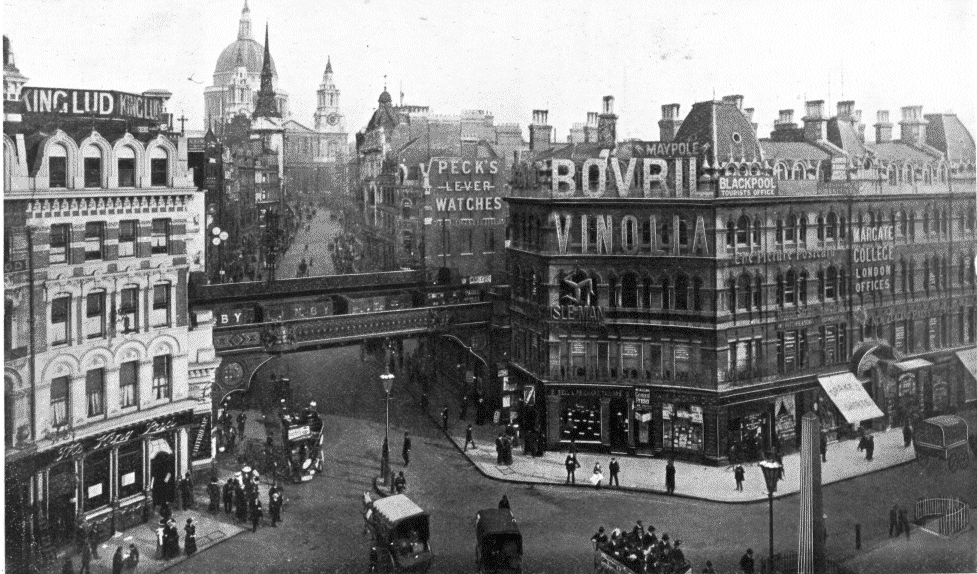
Advertsing was everywhere in Victorian London - from hoardings, to giant signs around the city, inside and outside buses, to covering the front of newspapers. Check out this giant lettering on Ludgate Hill:


It was a boom industry in the 1880s and some saw it as a pernicious influence. George Gissing's In the Year of Jubilee (1894) - a marvellous novel, by the way - tackles it in typically pessimistic fashion:-

"Sitting opposite to Samuel, she avoided his persistent glances by reading the rows of advertisements above his head. Somebody's 'Blue;' somebody's 'Soap;' somebody's 'High-class Jams;' and behold, inserted between the Soap and the Jam--'God so loved the world, that He gave His only-begotten Son, that whoso believeth in Him should not perish, but have everlasting life.' Nancy perused the passage without perception of incongruity, without emotion of any kind. Her religion had long since fallen to pieces, and universal defilement of Scriptural phrase by the associations of the market-place had in this respect blunted her sensibilities."

My favourite Victorian advert is this one from 1879 or thereabouts:
Apart from the fact that the Victorians had 'washing-machines', it's the endorsements - always a feature of serious Victorian adverts - that amaze and astonish.

'In a few hours yesterday, two boys worked off the washing of the whole institution, containing nearly two hundred inmates.'

In other words, Buy the Bradford Washing-Machine - as tested by orphans!

Likewise,

'My servants wash more clothes and much better in one day with your Machine than they used to do in three days without it.'

That one line tells you more about Victorian domestic life than many a book.

Newspaper adverts often filled columns with similar appeals to the casual reader. I was thinking about adverts today because I came across this in Punch from 1881, entitled 'How We Advertise Now' ... a parody of the form, but quite accurate:

Possibly it's not that funny today - how many people are familiar with Victorian small ads, after all? - but I like some of the sheer silliness here, a vein in English humour which still persists to the modern day ...

'ESSENCE OF JINGOE. - Is the remedy for Archbishops.
ESSENCE OF JINGOE. - Is a of great assistance to Amateur Actors.
ESSENCE OF JINGOE. - Is a necessity for Acrobats.'

'JUST READ THIS:
"I have been a martyr to Nervous Irritability for upwards of seventeen years. The slightest contradiction at dinner caused me to throw a soup-plate at the head of anybody I could see. I have got through whole services, and was nearly ruining myself when I sent for a double-sized quantity of your ESSENCE, and gave the whole of it in a cup of coffee to my mother-in-law. The effect was marvellous. We buried her last Tuesday, and I am an altered man. I find myself singing without knowing why. You are at liberty to make what use you like of this, witholding my real name for fear of the Police. - X. The Swallows, Herts."
Les Dawson would have been proud.*

(*Younger viewers should refer to Wikipedia and Youtube for that - thoroughly Victorian - comedian of the 1970s and 80s. Sample joke, although not great without his delivery, "I can always tell when the mother in law's coming to stay; the mice throw themselves on the traps.")