Showing posts with label Ludgate Circus. Show all posts

Thursday, 14 October 2010

The Lost Obelisk of Ludgate

I've often wondered, looking at 19th C. pictures of London, why there was an obelisk at Ludgate, when it got there, and when it disappeared. See this picture for example:

The obelisk is in the middle of the carriage-way, surrounded by railings and (oil) lamps attached. The obelisk is still there, minus the lamps, at the end of the century, even after the junction has been expanded to become 'Ludgate Circus' in the 1860s (nb. you can enlarge this pic for a great view).


A closer look at this picture actually reveals two obelisks, something I had not realised. Fortunately, it doesn't take long to Google the answer.

The first of the two obelisks was, seemingly, erected in honour of 18th C. politician John Wilkes (1727-97) but Public Sculpture in the City of London by Philip Ward-Jackson (a book which I am now going to buy) tells us different:

"For over a century and a half after his death, it was believed ... that Wilkes was commemorated by an obelisk with lights attached to it at the southern end of Farringdon Street ... An inspection of the Corporation Records in 1949, however, proved that this had originally been erected by the Blackfriars Bridge Committee as a street lamp, and had had Wilkes' name placed on it only because it was put up in his mayoralty. The obelisk had deterioriated to such an extent by this time, that, when in the following year, an attempt was made to dismantle it, it disintegrated."

This is supported by various references in the press, and a final mention in the Times that the obelisk was "erected in 1775 by the Blackfriars Bridge Committee to 'support four lamps to enlighten the footway'." So much for obelisk no.1 (the most southerly, nearest the bridge).  What about the second one?

The same book, luckily, gives the answer. It was erected in 1833 to honour the memory of the recently deceased Robert Waithman, a linenpdraper whose premises were nearby. Waithman was also a prominent City of London politician, and was voted City member of parliament in five successive elections; hence it's understandable why future generations assumed the other obelisk was built to honour another 'radical' politician, Wilkes.

There's a lovely piece in the Times about the opening of the monument, and why it was contained by railings:

THE WAITHMAN OBELISK - Although it has been objected that the people of England are too prone to destruction of works of art, and that England is the only country in Europe where it is necessary to protect such works by iron railways, and to request persons to leave their sticks and parasols below at exhibitions of pictures, and to keep them at arm's length by bars, the committee and architect of the Waithman's obelisk, in consideration of the extreme hardness of the materials, and the broad simplicity of the design, had determined not to enclose it with railing, but to give their fellow-citizens an opportunity of redeeming this part of the national character. Yet a few hours had hardly passed after opening it to the public when wanton curiosity, to ascertain whether it was real granite or not, has injured and defaced the fine arrisses and points of some of the bold Roman letters, and other parts of the sculpture, and dirty feet marks are visible in clambering on the  steps and cornice. The British nation have now the disgrace of seeing this beautiful work of art enclosed by a temporary chevaux de frise, till the committee surround it by an iron railing.

The Wilkes obelisk, as mentioned above, disintegrated. It was not only fragile but 'sinking perceptibly into the gentlemen's lavatory beneath it.' The Waithman memorial, however, survived. It was removed and replaced with the new innovation of automatic traffic lights. It was sent to Bartholomew Close, near Aldersgate, then moved again in 1975 to Salisbury Square / Salisbury Court.

It's still there today, somewhat unknown and unloved. I've seen it many times and never realised its origin.


Image courtesy LondonDave on Flickr
http://www.flickr.com/photos/londondave/2171129165/


Thursday, 26 August 2010

How We Advertise Now

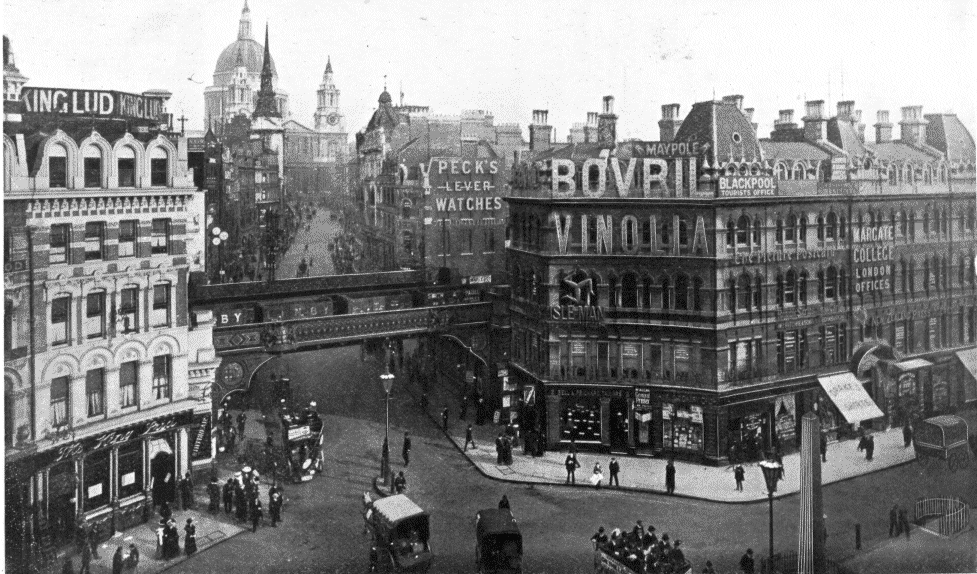
Advertsing was everywhere in Victorian London - from hoardings, to giant signs around the city, inside and outside buses, to covering the front of newspapers. Check out this giant lettering on Ludgate Hill:


It was a boom industry in the 1880s and some saw it as a pernicious influence. George Gissing's In the Year of Jubilee (1894) - a marvellous novel, by the way - tackles it in typically pessimistic fashion:-

"Sitting opposite to Samuel, she avoided his persistent glances by reading the rows of advertisements above his head. Somebody's 'Blue;' somebody's 'Soap;' somebody's 'High-class Jams;' and behold, inserted between the Soap and the Jam--'God so loved the world, that He gave His only-begotten Son, that whoso believeth in Him should not perish, but have everlasting life.' Nancy perused the passage without perception of incongruity, without emotion of any kind. Her religion had long since fallen to pieces, and universal defilement of Scriptural phrase by the associations of the market-place had in this respect blunted her sensibilities."

My favourite Victorian advert is this one from 1879 or thereabouts:
Apart from the fact that the Victorians had 'washing-machines', it's the endorsements - always a feature of serious Victorian adverts - that amaze and astonish.

'In a few hours yesterday, two boys worked off the washing of the whole institution, containing nearly two hundred inmates.'

In other words, Buy the Bradford Washing-Machine - as tested by orphans!

Likewise,

'My servants wash more clothes and much better in one day with your Machine than they used to do in three days without it.'

That one line tells you more about Victorian domestic life than many a book.

Newspaper adverts often filled columns with similar appeals to the casual reader. I was thinking about adverts today because I came across this in Punch from 1881, entitled 'How We Advertise Now' ... a parody of the form, but quite accurate:

Possibly it's not that funny today - how many people are familiar with Victorian small ads, after all? - but I like some of the sheer silliness here, a vein in English humour which still persists to the modern day ...

'ESSENCE OF JINGOE. - Is the remedy for Archbishops.
ESSENCE OF JINGOE. - Is a of great assistance to Amateur Actors.
ESSENCE OF JINGOE. - Is a necessity for Acrobats.'

'JUST READ THIS:
"I have been a martyr to Nervous Irritability for upwards of seventeen years. The slightest contradiction at dinner caused me to throw a soup-plate at the head of anybody I could see. I have got through whole services, and was nearly ruining myself when I sent for a double-sized quantity of your ESSENCE, and gave the whole of it in a cup of coffee to my mother-in-law. The effect was marvellous. We buried her last Tuesday, and I am an altered man. I find myself singing without knowing why. You are at liberty to make what use you like of this, witholding my real name for fear of the Police. - X. The Swallows, Herts."
Les Dawson would have been proud.*

(*Younger viewers should refer to Wikipedia and Youtube for that - thoroughly Victorian - comedian of the 1970s and 80s. Sample joke, although not great without his delivery, "I can always tell when the mother in law's coming to stay; the mice throw themselves on the traps.")